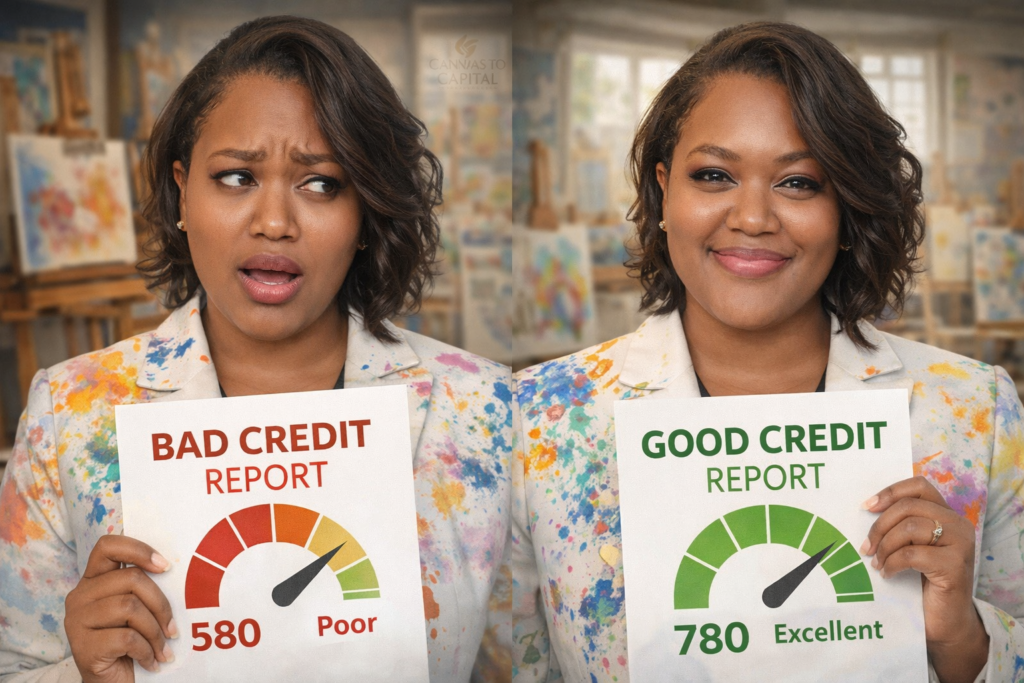
Until a few years ago, I didn’t truly think about credit as an asset. It felt more like a background number—something that existed, something that mattered, but not something I was actively building. I knew it mattered, but I didn’t understand HOW much it mattered and how deeply it could influence what was possible in my life. And I definitely didn’t understand that managing credit had very little to do with knowing the rules… and everything to do with discipline.
What I’ve been learning over the past few years is that credit isn’t built on big, exciting moments. It’s built in small, quiet decisions such as intentionally not maxing out a card even when you technically can or choosing not to open something you don’t actually need. There is nothing glamorous about it, and if I can be honest, that’s exactly why I struggled with it for a long time. As a creative, I’ve always been drawn to movement, momentum, big ideas, and visible progress. Credit doesn’t reward that. It rewards consistency. And that was a shift I had to grow into.
But what really changed everything for me wasn’t just understanding credit—it was experiencing the difference. See, I have lived with bad credit and I have lived with mediocre credit. And now, I’ve experienced what it feels like to have good credit. And let me tell you—the difference is not small. It is not subtle. It is a completely different world. Granted, I am still growing in the credit game because I am acutely aware now of what credit can do!
When my credit wasn’t strong, I didn’t fully realize what was happening. I thought things were just… harder, expensive and complicated. I accepted higher payments. Higher interest rates. More hoops. More “we’ll see.” More no’s. I thought that was just part of the process.
But when my credit improved, I had a moment that honestly shook me. Doors started opening that I didn’t even know existed.Not just approvals—but better options. Lower rates. Smoother processes. Conversations that felt different. Opportunities that were never presented to me before suddenly became available. It wasn’t just about getting approved—it was about how I was treated in the process. The experience shifted.
And I remember thinking… “Wait… this was here the whole time?” I felt flabbergasted, played, hoodwinked, if I’m being real. Because no one really explains it like this. No one tells you that without strong credit, you’re often paying faaaaaar more for the same things—or being quietly excluded from better ones. That you’re operating in a limited version of what’s actually available. And once I saw that, I couldn’t unsee it.
That’s when I truly understood that credit is not just a financial tool—it’s access to better terms, opportunities and leverage. And leverage, when used correctly, is what allows you to move from simply working for money… to actually building with it.
Especially as creatives, this matters more than we realize. Because if your vision requires space, time, or capital—credit becomes part of the foundation whether you acknowledge it or not. You can have talent, vision, and even income—but without structure, without discipline, without credit, your options stay limited. And that’s a hard truth.
What I had to accept—and what I want to offer to you—is that improving your credit is not about chasing a number. It’s about becoming the kind of person who can be trusted with financial responsibility. That’s a deeper shift. Because once you see it that way, the question is no longer “How do I raise my score quickly?” It becomes “What habits am I practicing daily that either build trust… or break it?”
Because at the end of the day, credit is simply a reflection of your patterns – not your intentions or potential- but your patterns!
In real life, that looks like paying things on time—even when it’s inconvenient. Keeping your balances low—even when you have room to spend. Being intentional instead of reactive. And learning to be patient.
Admittedly… that last one is the hardest. Because discipline is quiet, repetitive and unseen. But that is exactly where everything begins to change.
Credit is an invisible asset. You don’t always see it working for you—but you will absolutely feel it when it’s not there. And when it is there, it doesn’t just make things easier—it expands what’s possible. And that’s the part I wish more people understood.
This isn’t just about money. It’s about access, alignment and positioning yourself for the life you say you want to build.