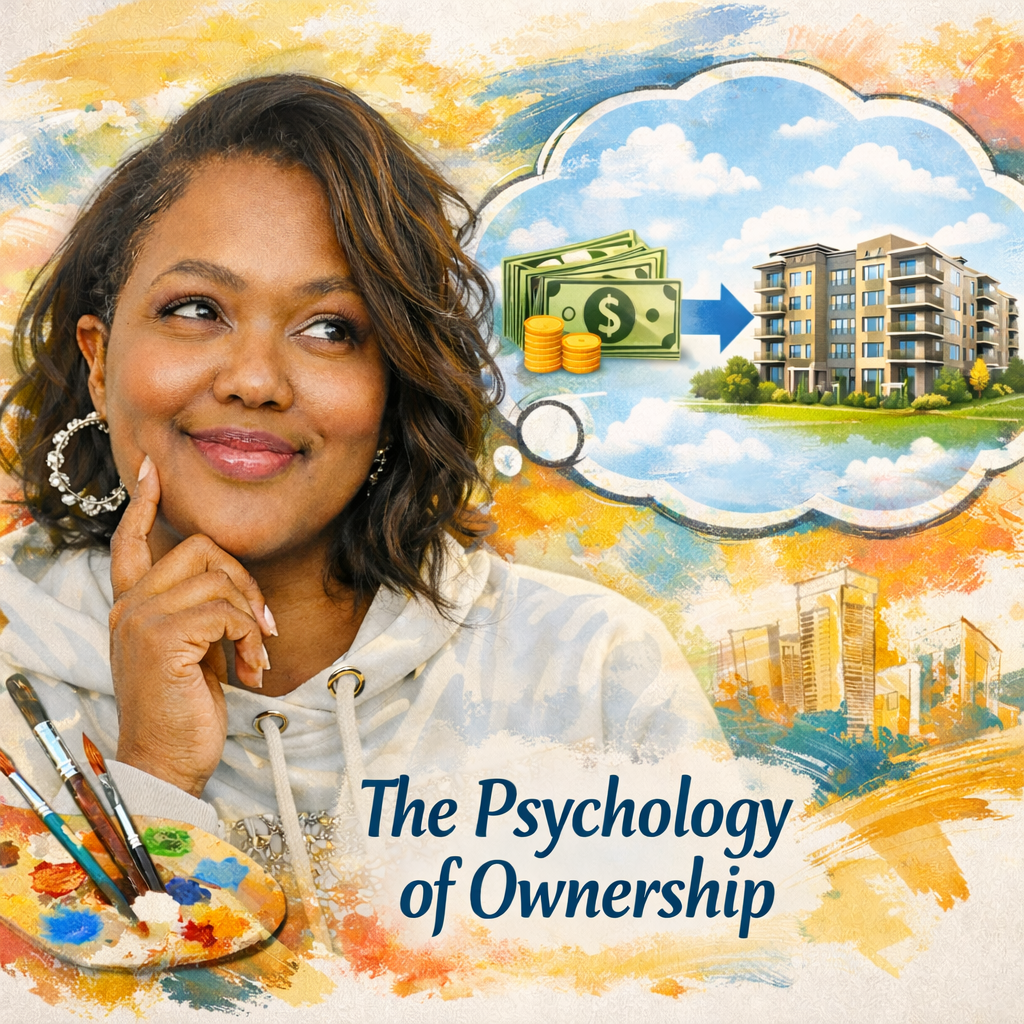
“Most importantly, it requires the humility to admit that the way you’ve been doing things may not lead where you hope to go.”
If you were raised anything like me, you were grounded in studying hard, developing skills and building a solid career. We know the power of consistent, hard work. They’ve allowed us to create stability (even when wer’re bopping all over the world lol), purpose, and dignity in our work. My own career as an artist, educator, and entrepreneur was built on those principles.
But several years ago, a realization began to quietly unfold deep in my spirit. Earning and owning are not the same thing. You can earn a good living for decades and still never truly build wealth. This is something that isn’t discussed often enough, particularly among creative professionals. We are taught to value mastery, craft, and contribution — all beautiful pursuits — but rarely are we taught to think deeply about ownership. Ownership operates on a completely different psychological framework. When you are focused only on earning, your mindset revolves around effort. You are rewarded for what you produce, what you sell, what you deliver. The moment you stop producing, the income typically stops as well.
Ownership changes the equation. Ownership asks a different question What continues to produce value even when I am not actively working? Assets behave differently than income. They grow quietly. They compound slowly. They reward patience more than hustle. And yet, many of us spend decades perfecting the psychology of effort while never developing the psychology of ownership.
For a long time, I was doing exactly that. I built projects. I created work I cared deeply about. I generated income in multiple ways. But I had to eventually confront an uncomfortable truth: My career, by itself, was not a wealth strategy. That realization wasn’t dramatic. It was more like a slow awareness that settled in over time. The math simply didn’t work the way I had assumed it would. Savings alone would not create the kind of freedom I envisioned. A career — even a successful one — was still tied to my time and energy. If I wanted something different in the future, I would have to begin thinking differently in the present.
That’s when ownership started to occupy more of my attention. Real estate. Equity. Long-term investments. Assets that could exist independently of my daily effort. But the shift wasn’t just about learning new financial strategies. The deeper work was internal. Ownership requires patience in a world that rewards speed. It requires discipline in a culture that celebrates consumption. And perhaps most importantly, it requires the humility to admit that the way you’ve been doing things may not lead where you hope to go.
My blog Canvas 2 Capital is, in many ways, a record of that psychological shift. The artist in me still believes deeply in creativity, vision, and building things that matter. But I’ve begun to realize that those same qualities can also be applied to building assets. A painting starts with an empty surface and a long horizon of patience. Wealth — real wealth — often begins the same way. Slowly. Quietly. Layer by layer.
Ownership is not simply a financial concept. It is a way of thinking about the future. And once you begin to see the world through that lens, it becomes very difficult to go back.