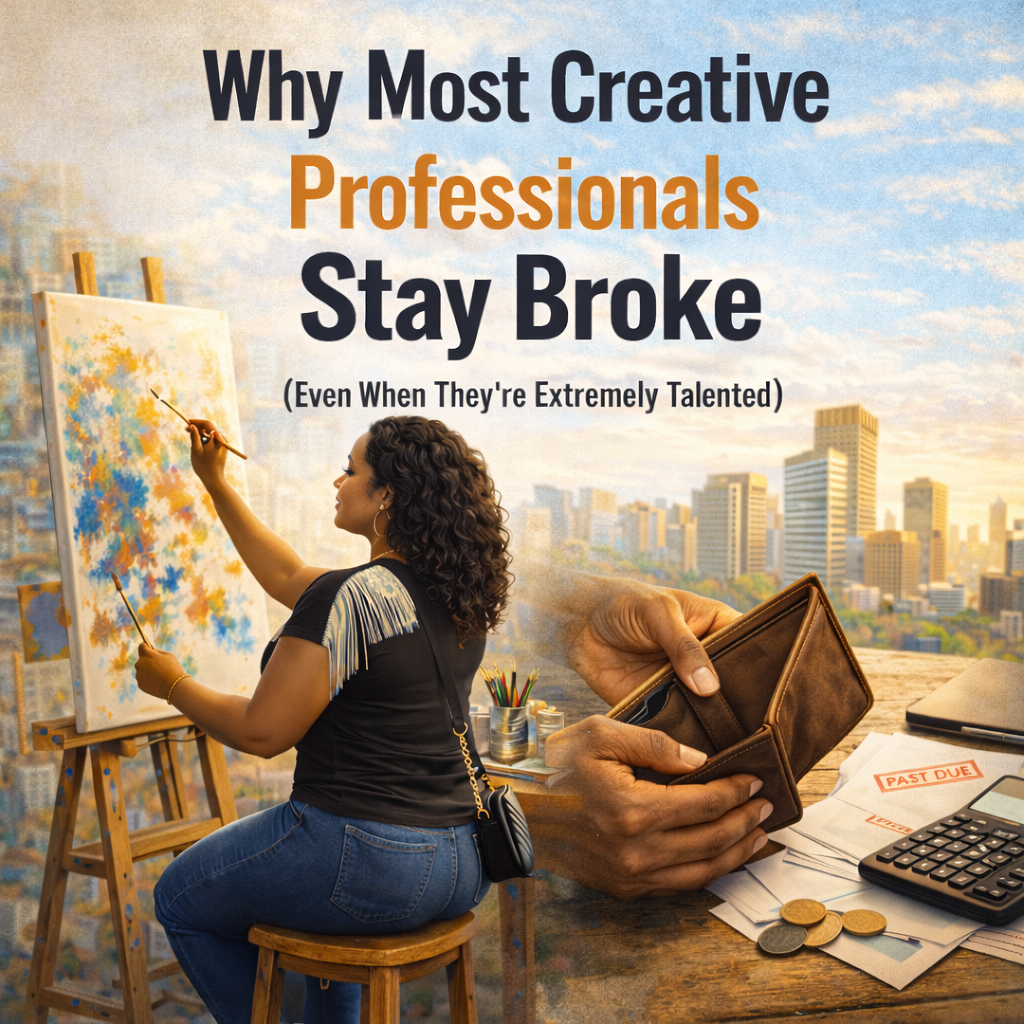
Why Most Creative Professionals Stay Broke (Even When They’re Extremely Talented)
Over the years I’ve met some extraordinarily talented people.Painters whose work stops you in your tracks. Designers who can see beauty and possibility where others see blank space. Writers who can translate emotion into language with precision and depth.Talent has never been the problem.
In fact, many of the most creative people I know are also some of THE hardest working. They produce constantly. They innovate. They build projects from nothing. They pour themselves into their craft.And yet, despite all of that talent and effort, many creative professionals struggle financially. Not because they lack discipline. Not because their work lacks value. And certainly not because they lack intelligence.The real issue is much simpler.
Most creative professionals are trained to generate income, but not to build assets. From an early age, we are encouraged to focus on mastering our crafts. We are taught how to create, how to perform, how to produce meaningful work. We learn how to refine our voice, develop our skill, and eventually earn money from what we create. What we are rarely taught is how to turn that income into something that grows beyond our labor. In other words, we know how to produce. But we are rarely taught how to own. That difference changes everything.
Income—even good income—depends on continued effort. It requires time, energy, and constant output. When the work stops, the income often stops too. But assets continue working even when you are not. Real estate, strong stock positions, ownership in businesses, equity in investments—these are the kinds of structures that create long-term financial stability. They build quietly in the background over time. Many creative professionals spend years building remarkable careers without ever realizing that the system itself is incomplete.
I know this because I lived it.
For most of my life, creativity was the center of everything I did. I built a career teaching art. I ran a gallery and studio. I pursued entrepreneurial ideas and built projects that I cared deeply about. And to be clear, those experiences were incredibly valuable. Creativity has shaped the way I see the world and the way I approach problems.
But at some point, I had to confront an uncomfortable truth: Making money and building wealth are two entirely different skill sets. My career had taught me how to create value and generate income. But it had not yet taught me how to systematically acquire assets. That realization changed the way I started thinking about work, ownership, and long-term strategy.
In the studio, artists understand something important about the creative process: the most important layers of a painting often happen before the image becomes visible. The early stages are structural. Texture is built. The composition begins to take shape. Foundations are laid that determine whether the final piece will hold.
Wealth works in a similar way. The visible parts—income, success, opportunity—are only the surface. Underneath that surface, there has to be structure: assets, ownership, and disciplined financial strategy. Without those layers, even a successful career can remain financially fragile.
This realization is one of the reasons I began focusing more intentionally on real estate and investing. Not as a replacement for creativity, but as a structure that allows creativity to exist with greater freedom. When income is paired with ownership, something powerful begins to happen. The work you love no longer has to carry the entire weight of your financial life. Assets begin to quietly support the structure.
Creative professionals don’t stay broke because they lack talent. They stay broke because no one ever taught them that creativity alone isn’t a financial strategy. But creativity combined with ownership—that’s where things start to change. And that shift—from canvas to capital—is a journey more creatives should be encouraged to take.